Severe winter conditions in the mountains
The Drover's WifeSevere winter conditions in the mountains are a decisive physical threat to the children travelling toward Yadaka’s cave, while Molly is held in the Everton jailhouse. Heavy, unprecedented snowfall leaves the landscape dangerous and the children’s survival uncertain; their progress depends on endurance, Danny’s responsibility for his siblings, and his knowledge of the cave’s landmark boulders. The winter also sharpens the novel’s contrast between imposed confinement and movement grounded in knowledge of Country and the seasons.
Winter as an Immediate Danger
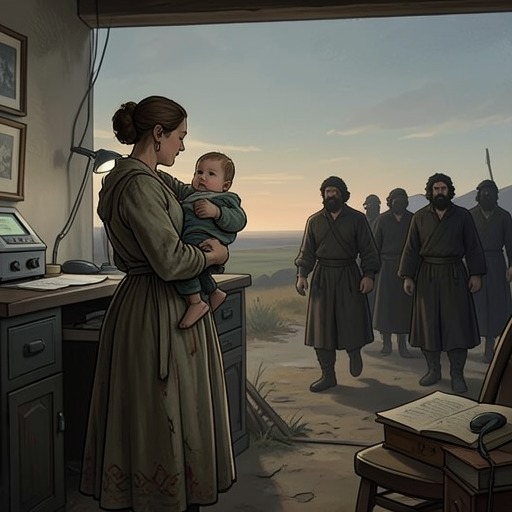
From her cell window, Molly sees snow covering the land and the distant mountains. She worries that the conditions are no good for the children and fixes her attention on their journey to Yadaka’s cave. When Nate tells her that an old tracker from the northern party expects a very cold winter and unprecedented snowfall, the weather becomes more than a general forecast: it is a specific danger bearing down on the route her children must cross.
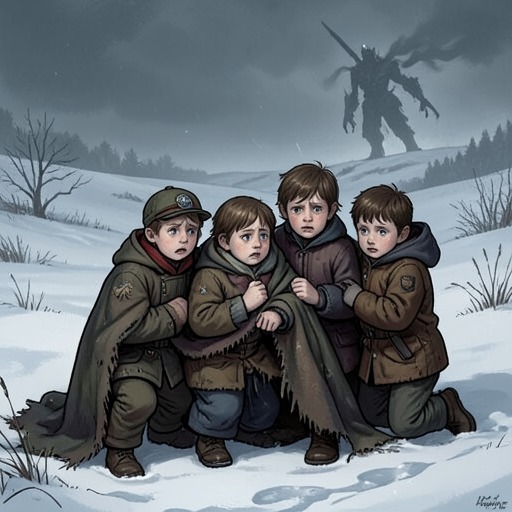
The children encounter that danger directly. High in the mountains, snow lies deep enough to reach their knees, and the effort of continuing leaves them exhausted and bitterly cold. A branch cracks under the weight of the snow, startling the boys. Henry James falls from exhaustion, while Danny carries a frostbitten Delphi on his back; the uncertainty over whether she is sleeping or dead makes the conditions’ threat to the youngest child especially immediate. The scene presents winter not as picturesque scenery but as an obstacle with consequences for the children’s bodies, pace, and chances of reaching shelter.
The Search for the Cave
The storm conditions compound the difficulty of finding the cave. Danny reaches a cleared circular space and looks among the boulders for three arranged like large emu eggs, the landmark that will guide the children to the entrance. At first he cannot find them. With his siblings close to giving up and the responsibility of saving them weighing on him, the search becomes a test of whether he can turn remembered knowledge into a route through an unfamiliar, snow-covered landscape.
Danny then sees a red-haired woman beside a boulder, but when he blinks she is gone. Looking again, he finds the three large boulders in place. He recognizes that he has reached the right landmark and tells his brothers that the cave lies just beyond it. The discovery does not erase the danger of the journey, but it gives the exhausted children a clear destination and carries them to the shelter they have been seeking.
Molly’s Separation and Vigil
The winter’s severity is especially painful because Molly cannot accompany or protect the children. Imprisoned at Everton, she stands on a stool to look through the small cell window toward the snow-covered country. Her attention settles on the mountains, and she wills her children to survive the passage to the cave. When Nate reports that the trackers can no longer find their tracks, the information offers no certainty about their condition or whereabouts. The snowfall has obscured the evidence of their movement, leaving Molly to wait without knowing whether they have reached shelter.
Her songs and her gaze link the prison cell to the distant mountain journey. In the cell, she sings of black hair and looks toward the children’s route; outside, they struggle through the snow toward a place associated with Yadaka. The winter thus separates mother and children materially as well as emotionally: she can see the mountains but cannot reach them, while the children must make their way without her.
Seasonal Knowledge and Survival
Earlier, Yadaka explains the seasonal movement of his people: when the first mist rises in the valleys, they leave the mountain and travel north for winter, both to avoid the cold and to follow the season’s change. Danny recognizes that the first mist has already appeared and asks why Yadaka is still there. The exchange establishes a practical knowledge of weather and movement, and gives the children’s later mountain journey a context beyond flight: the land is crossed through routes and seasonal understanding, not merely traversed as empty terrain.
That knowledge exists under colonial pressure. The novel describes white settlers taking land, fencing it, and driving Aboriginal people from their homelands, restricting their ability to move with the changing seasons. Against that history, the children’s attempt to reach the cave takes place in a landscape whose dangers are intensified by displacement and separation from community. The winter is severe in itself, but the circumstances that leave Molly in custody and her children travelling alone shape who must face it and with what support.
Narrative Significance
The snow creates a stark contrast between Molly’s confinement and the children’s exposed passage through the mountains. In Everton, the weather reaches Molly through the cell window and the tracker’s report; on the mountain, it determines how far the children can walk and threatens their ability to continue. The cave’s recognizable boulders offer a narrow opening toward safety, but the route makes that safety contingent on Danny’s persistence and the siblings’ shared effort.
The winter also gives physical force to the novel’s concern with survival under unequal conditions. Molly’s hope cannot clear the snow or reunite the family, and the children’s knowledge of their destination cannot spare them the cold. Yet Danny’s recognition of the landmark turns the search from uncertainty toward arrival. The episode therefore makes the severe weather both an independent peril and the setting in which familial responsibility, geographical knowledge, and the possibility of shelter are tested.